Integration with OpenAI's GPT and other LLMs
ClaimMaster Integration With GPT and Other LLM Programs
ClaimMater can integrate with OpenAI GPT running in the cloud (either OpenAI or Azure) and also several Large Language Models ("LLMs") applications executing locally on the computer. OpenAI GPT (Generative Pre-trained Transformer) is an advanced language model for natural language processing. GPT is built on the Transformer architecture, a deep learning model that specializes in processing sequential data. GPT is pre-trained on a massive corpus of diverse text from the internet, allowing it to learn the statistical patterns, grammar, and semantics of human language. It can then generate coherent and contextually relevant responses to given prompts, making its a helpful tool for various generative applications including patent drafting, paraphrasing, and summarizing.

In addition, you can connect ClaimMaster to use a local LLM via a desktop application, such as Ollama or LM Studio. When running a local LLM, your data remains completely private and is not sent to the cloud for processing. If you have data privacy concerns about cloud-based OpenAI/Azure GPT applications, using such a local LLM in combination with ClaimMaster is an excellent alternative to GPT that lets you have a completely private AI-enhanced patent drafting solution.

ClaimMaster's patent drafting tools let you store and invoke helpful GPT/LLM prompts enriched with the text from your documents to describe figures, and also to generate, rewrite, and summarize text. To do so, ClaimMaster connects via API to either (1) OpenAI's or Microsoft Azure OpenAI's GPT services or (2) to a desktop application running a local LLM, such as Ollama or LM Studio. When connecting to the cloud-based GPT services, ClaimMaster will send and receive data to/from the selected GPT/LLM service using API directly from the computer where ClaimMaster is installed, without sending data for processing to any intermediate servers. According to OpenAI API policies and/or Azure OpenAI API policies, the use of API ensures that your prompts (inputs), completions (outputs), and any other transmitted data will not be available to other customers and will not be used to improve GPT models. To further enhance data privacy, you can also configure ClaimMaster with your own API key and endpoint (Azure) to connect to private models set up in OpenAI or Azure OpenAI services. If ClaimMaster is configured to access private GPT models using your API keys, those keys will be always stored in encrypted format on a machine where ClaimMaster is installed. When connecting to a local LLM application, your data remains completely private and is not sent to the cloud for processing.
To further enhance output from GPT/LLMs, ClaimMaster can also use a local database of documents to perform Retrieval Augmented Generation (RAG) when generating text. RAG is the process of retrieving relevant contextual information from a database of document snippets and passing that information to the LLM alongside the user’s prompt. This information is used to improve the LLM’s generated output by augmenting the model’s base knowledge. The RAG architecture in ClaimMaster uses semantic searching to find contextually relevant data based on the conceptual similarity of the input prompt and uses those vectors to search the vector database for the closest conceptual matches. As a result, when you send a prompt to GPT/LLM, ClaimMaster will first query its local vector database that contains your workspaces to find the most similar text snippets for your prompt and will then add those snippets to the final prompt of the configured GPT/LLM source to improve its output results.
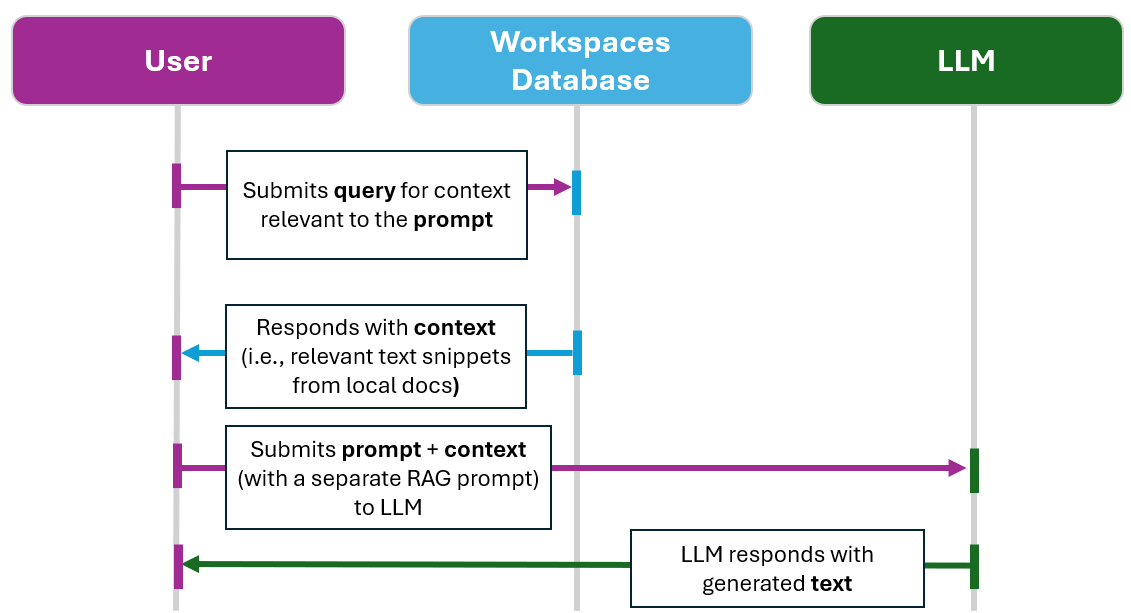
Basic ClaimMaster RAG workflow
When connecting to cloud-based GPT service, you are responsible for determining whether OpenAI API policies and/or Azure OpenAI API policies suit your needs, satisfy your organization's security requirements, and assume all risk for using GPT services with your confidential data. All GPT features in ClaimMaster will only transmit data to GPT/LLM after your explicit command. You control exactly what data is being sent to GPT/LLM. It's also a good practice to always review GPT/LLM responses for factual correctness, especially if you are using prompts with settings for higher response randomness/creativity.
To explore our GPT/LLM tools in more detail, click on the links below: